

Rehab Material Tracking: Receipts, Deliveries, and Returns
Paying for your own rehab materials gives you visibility only if you look at the purchases.
In my execution training, I show how I review receipts and ask about quantities. If something seems out of line with the scope, I ask the contractor to explain it while the purchase is still fresh.
That is a normal part of running the project. It does not require treating every contractor as suspicious.
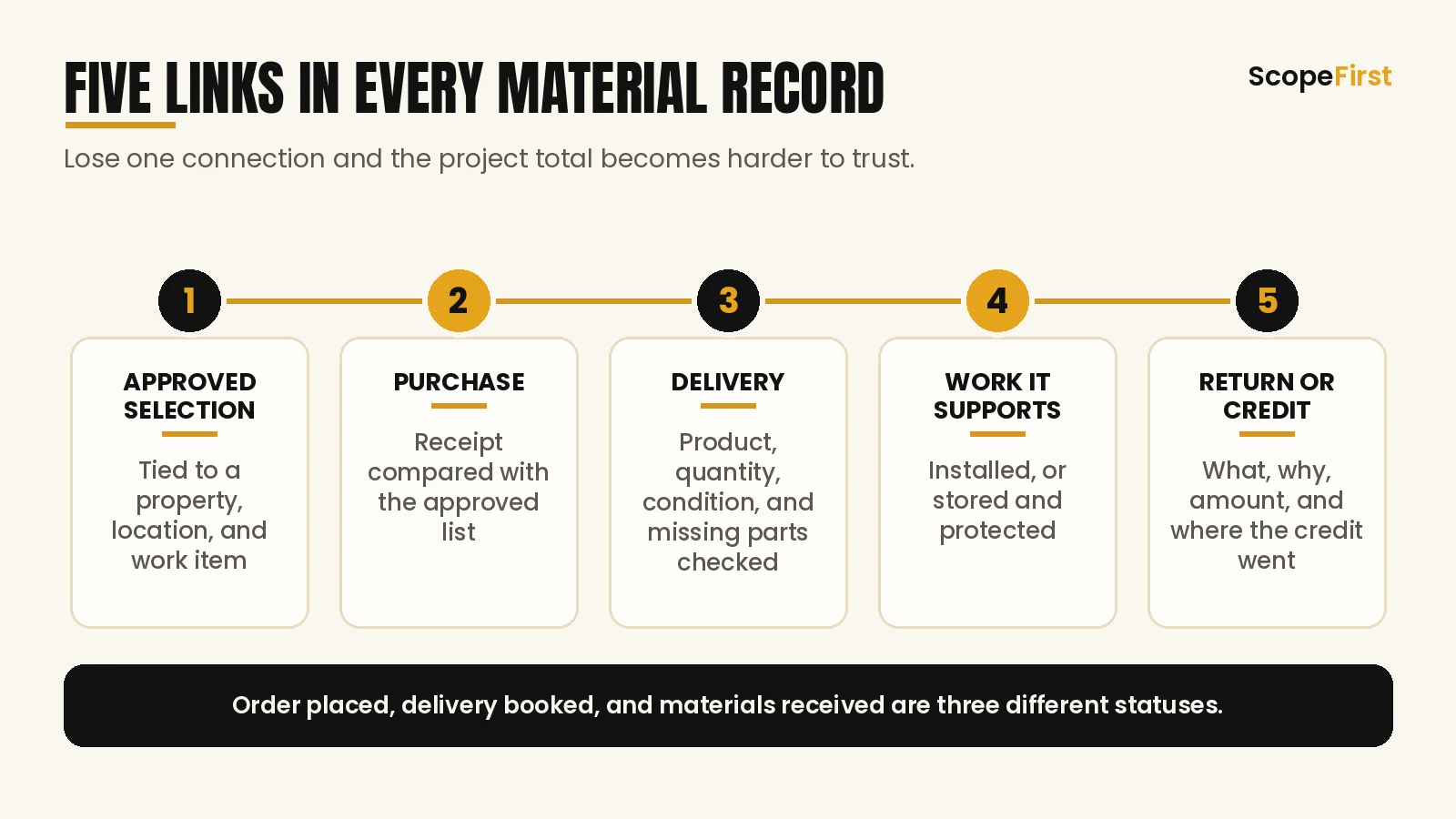
A useful rehab material record connects five things: the approved selection, the purchase, the delivery, the work it supports, and any return or credit. Lose one of those connections and the project total becomes harder to trust.
Start with the scope reference
Before an order is placed, connect it to a location and work item.
A receipt for flooring tells you what was bought. It may not tell you which property, which rooms, whether the quantity was verified, or whether the selected product changed.
Record the property and scope reference when the order is made. For shared purchases across projects, allocate the costs using a clear record rather than guessing at the end of the month.
Keep the installer responsible for confirming the quantities and product requirements within the agreed arrangement. An investor's preliminary measurement should not silently become the final ordering instruction.
Agree on what can go on the account
In my own system, I explain that tools, snacks, and drinks are not project-material purchases I authorize. Other businesses may structure their agreements differently.
The important part is telling the contractor before the purchase. Identify who can order, what approval is needed, which project the purchase belongs to, and how urgent small items will be handled.
Set a process that works when you are unavailable. Otherwise, the contractor may be standing at the store while you are in a meeting, and everyone is frustrated by a rule nobody discussed.
Use the supplier's supported authorization method. Do not casually distribute account credentials or card details to solve an avoidable coordination problem.
Review the receipt while it still means something

Compare the purchase with the approved list.
Is the model correct? Does the quantity make sense? Are related components included? Is something for a later stage being bought early? Has a product been substituted?
A quantity question can be straightforward: “We planned for this area. Can you walk me through the amount ordered and the waste allowance?” There may be a good reason. The record should capture it.
If the purchase differs from the approved selection, identify who approved the change and whether it affects the work. Do not wait until the installed product is the first evidence you see.
Delivery needs its own check

Order placed, delivery booked, and materials received are three different statuses.
Assign someone to receive the delivery and inspect it promptly. Check the product, quantity, visible condition, and missing components. Follow the supplier's reporting process when something is damaged or incorrect.
In training, I use damaged tile as a simple example. You want the issue recorded while there is time to arrange a replacement, not when the installer opens the boxes with a crew waiting.
Also decide where the material will be stored and how it will be protected. A correct delivery can still become a problem after it reaches the property.
Close the loop on returns
The original receipt is only half the story when items go back.
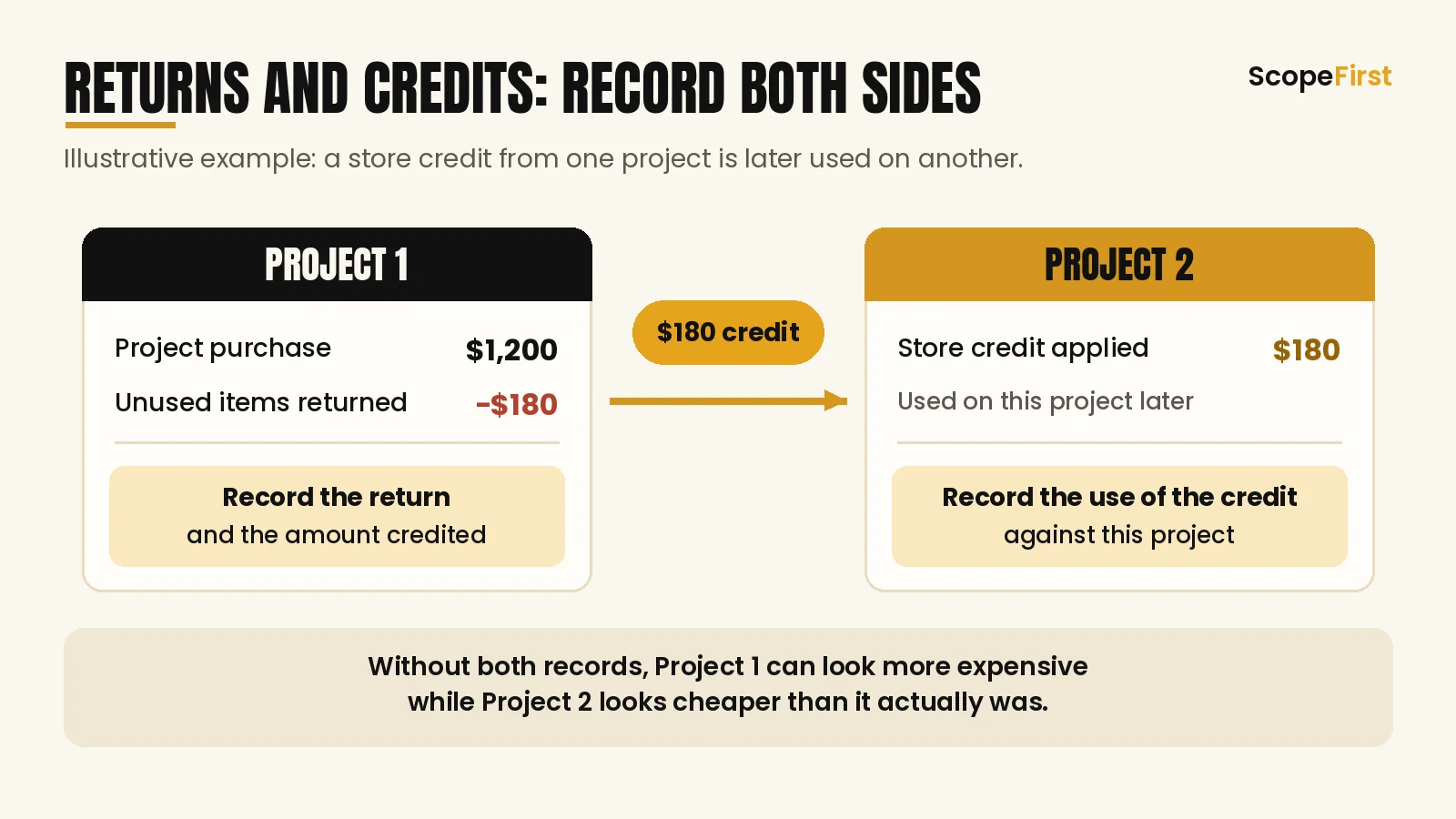
Record what was returned, why, the amount credited, and where the credit went. A refund to the original payment method, a store credit, and a replacement item affect the project record differently.
Here is an illustrative example:
A project purchase totals $1,200. Unused items worth $180 are returned. The store issues a $180 credit that is later used for another project.
The first project's record needs the return. The second project's record needs the use of the credit. Otherwise, the first can look more expensive while the second looks cheaper than it actually was.
Use your bookkeeping process for the final accounting treatment. The operational record should preserve enough evidence to reconcile it.
A material log you can actually maintain
Use these fields for each meaningful order:
- Property, room, and scope reference.
- Approved product and quantity.
- Person authorizing and placing the order.
- Supplier, order number, and amount.
- Required date and confirmed delivery arrangement.
- Recipient and delivery-check result.
- Installation or storage status.
- Return, credit, replacement, and supporting receipt.
You can keep this in a spreadsheet or a suitable purchasing system. It complements the scope; it is not presented here as a native ScopeFirst inventory feature.
Supplier tools may help too. Home Depot describes project-management features for deliveries and purchase history. Check the current features available to your account, and keep your project records understandable even when you buy from several suppliers.
Keep the checks proportional
You do not need an argument over every small consumable. You do need an agreed process, a usable record, and a way to notice patterns.
Review purchases alongside the work coming next. Investigate discrepancies promptly and fairly. Close out returns before the project disappears into an old message thread.
Start with the rehab scope checklist. ScopeFirst helps define the work; the purchasing record follows what you buy to complete it.