

My Hybrid Contractor Model: Who Handles Which Rehab Work?

A contractor can be excellent at one part of a renovation and the wrong choice for another.
That sounds obvious, but investors often hear “general contractor” and assume every part of the house is covered. Then the bid arrives without the foundation work, the HVAC, or even the final clean.
My hybrid contractor model starts by defining the work, then dividing it deliberately. I arrange selected specialty trades directly and use a contractor or crew for the remaining agreed work. That gives me more control over those relationships, but it also leaves more coordination with me.
It works when the responsibilities are clear. Without that clarity, you can end up with several contractors and nobody owning the gaps.
Choose the operating model before requesting the price
In my training, I describe three broad approaches.
A full general-contractor arrangement puts more of the coordination with one business. Confirm the actual scope of its service; the title alone does not tell you what is included.
Managing the individual trades yourself puts much more work on you. You need the time, knowledge, local support, and any required permissions to do it properly.
The hybrid model sits between those approaches. I keep selected specialist relationships direct and give the remaining crew a clearly defined package.
If you are remote, inexperienced, or unable to coordinate the job, buying more management support may be the sensible decision. Compare the service you receive along with the price.
The five majors get deliberate attention
The five major areas I emphasize are roof, foundation, HVAC, plumbing, and electrical.
I generally want direct conversations with the people handling that specialist work. I can ask what they are pricing, what they need ready, when they can arrive, and what documentation they will provide.
Other packages may also go direct. In my own training examples, that includes countertops, hardwood refinishing, demolition, or painting, depending on the project and crew.
This is a preference in my operating system. It is not proof that direct purchasing always costs less. A general contractor may provide useful procurement, supervision, scheduling, and risk management that you would otherwise need to arrange.
Give the remaining crew an actual boundary
The other crew might handle selected framing, trim, doors, cabinet installation, flooring, and other finishing tasks within its capabilities.
That sentence is not a scope yet.
I need to say which framing, which doors, what flooring, who supplies the products, and what the specialist trades will leave ready. I also need to know what the crew does particularly well. If a large drywall package is better handled by a dedicated drywall team, I would rather make that decision upfront.
Here is an illustrative handoff:
The electrical contractor completes the agreed electrical work. The finish crew completes the specified wall repairs and paint. Before closing or finishing any affected area, confirm the required inspections and the electrical contractor's readiness.
The project-specific requirements still need professional confirmation. The important part is that wall repairs did not disappear between two proposals.
Watch the interfaces
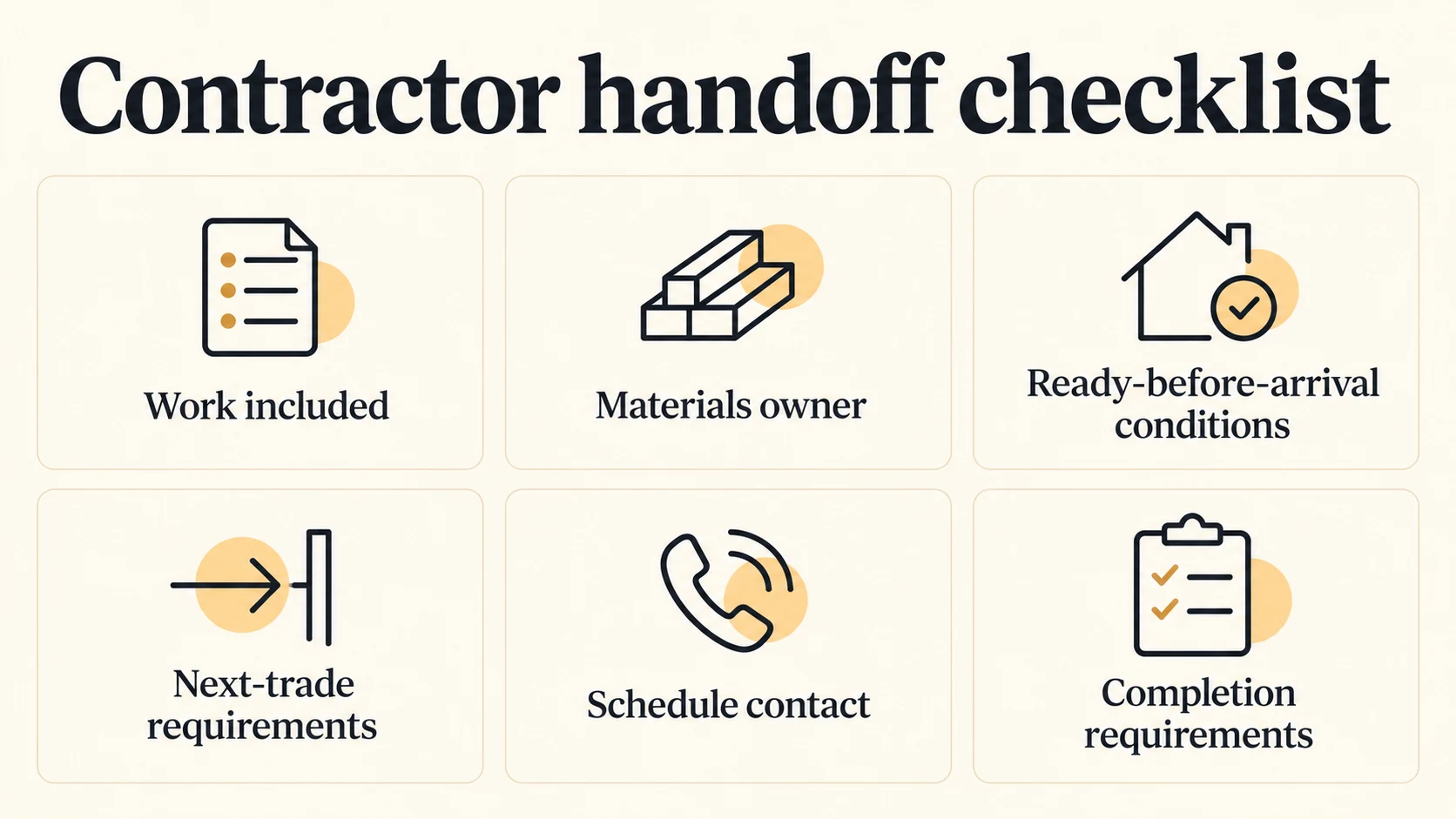
Most confusion appears where one person's work meets another's.
Who removes the old equipment? Who provides access? Who patches the opening? Who protects the finished floor? Who schedules the return visit? Who confirms that the next trade can start?
For each work package, record:
- Work included and excluded.
- Person responsible for materials.
- Conditions that must be ready before arrival.
- Work or documents needed before the next trade.
- Schedule contact.
- Completion and payment requirements.
Share the relevant plan with everyone affected. Being the only person who understands the sequence is a fragile way to run a project.
Build the contractor list before you need it
I teach investors to develop contacts while they are learning their market.
Talk to local contractors and suppliers. Ask other investors for specialty-trade referrals. If you approach a working crew, respect the site and ask permission before entering or discussing the work.
Record what the person actually does, where they work, how you met them, and whether they handle projects like yours. Then verify qualifications, insurance, references, and any required licensing before hiring.
A phone contact is a lead, not a vetted contractor. Keep that distinction in your records.
This also helps when someone is unavailable. You can make a relevant call instead of starting the search while the project waits.
Compare complete costs
If one proposal includes coordination and another is simply an installation price, the totals do not describe the same service.
Add back delivery, supervision, protection, cleanup, and other missing responsibilities before deciding what the hybrid approach saves. Include the time you will spend coordinating it. Confirm warranty terms with the actual parties rather than assuming a direct relationship creates a particular warranty.
My goal is a workable project and clear accountability. A low number with an unassigned task is not a finished budget.
Start with the scope guide and use the bid comparison process to make the divisions visible.
ScopeFirst supports the documentation. The people, agreements, and handoffs make the model work on site.